
Reframing the Narrative
What Youngstown’s New Mayor Can Teach Us About Strategic Messaging
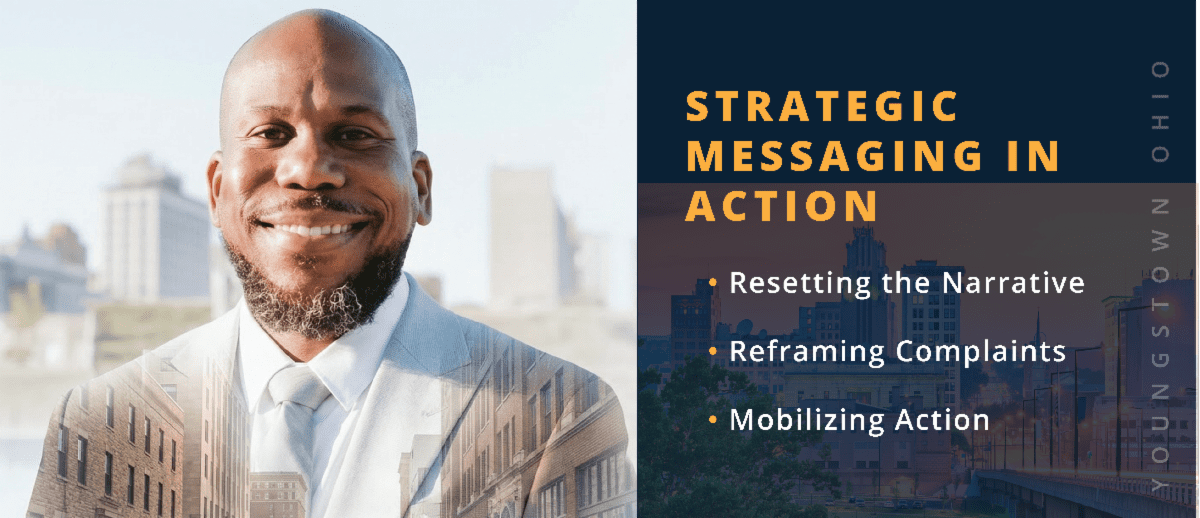
In public relations and marketing, one of the most powerful — and most difficult — things to manage is narrative. Every organization has one. Every community has one. And if you don’t actively shape it, someone else will.
Often, that narrative forms around frustration. Complaints grow louder than progress. Critics dominate the conversation. Over time, perception begins to overshadow reality.
At that point, the instinct for many is to defend themselves — to push back against criticism or explain why problems exist. But the most effective communicators know a different strategy: shift the focus.
Recently, Youngstown’s newly elected mayor, Derrick McDowell, has provided a fascinating example of this approach in action.
Through a series of Facebook posts he calls his “Sunday Sermons,” McDowell acknowledges many of the frustrations residents feel about their city — economic struggles, snow-covered sidewalks, forthcoming potholes, and civic pride. But instead of allowing those complaints to define the narrative, he reframes the conversation around shared responsibility.
Three Strategic Messaging Lessons
1. Reset the Narrative
Acknowledge challenges, but don’t allow them to define your brand story.
2. Reframe Complaints
Turn criticism into an opportunity for participation and shared ownership.
3. Mobilize Action
Clear calls to action, even simple ones, give people a way to contribute rather than complain.
When residents complain that sidewalks are not cleared for children walking to school, he asks a simple question: Did you shovel your portion?
When people criticize the city’s condition, he challenges them to show their love for the community by picking up trash, joining neighborhood groups, or helping others find work.
His message is consistent:
Youngstown improves when its residents participate in improving it.
Rather than reacting defensively to criticism, McDowell redirects the conversation toward shared responsibility and collective pride. The tone is conversational. The messaging is direct. And the language is memorable.
#HelpOrHush #ShovelYoSnow These aren’t just hashtags; they’re behavioral nudges that challenge people to move beyond commentary and toward contribution.
A Masterclass in Narrative Strategy
McDowell offers a powerful example for our businesses and organizations. Today, we operate in an environment where conversations can quickly spiral into negativity. Social media amplifies complaints. Customers air frustrations publicly. Employees share concerns in visible spaces. When left unmanaged, those conversations can quietly shape how your brand is perceived.
Strong leaders understand something critical: when messaging invites people into the solution rather than arguing against criticism, the tone of the conversation changes. And when people feel part of progress, they are no longer critics — they often become advocates.
For businesses navigating reputation challenges, customer dissatisfaction, or even internal morale issues, the lesson is simple:
Don’t just respond. Reframe.
Because the organizations that win the narrative don’t shout louder.
They tell a better story.