
After more than 30 years in this industry, you would think I would know better than to rush the creative process.
In fact, I do know better!
But sometimes a client has a very real deadline; there are financial consequences attached to it, and you think, We know this client. We can make this work.
That’s exactly what happened with
Jursa Family Insurance.
I had known Shannan Jursa for years through our work together with the Autism Society of Mahoning Valley.
MARQUEE had also created the identity for her Crash-A-Class teacher grant program, a logo she loved.
I knew her personality. I knew her style.
I knew what mattered to her.
Or so I thought.
When circumstances required Shannan to transition from an established insurance brand and quickly create an independent agency bearing her own family name, she had a lot happening at once.
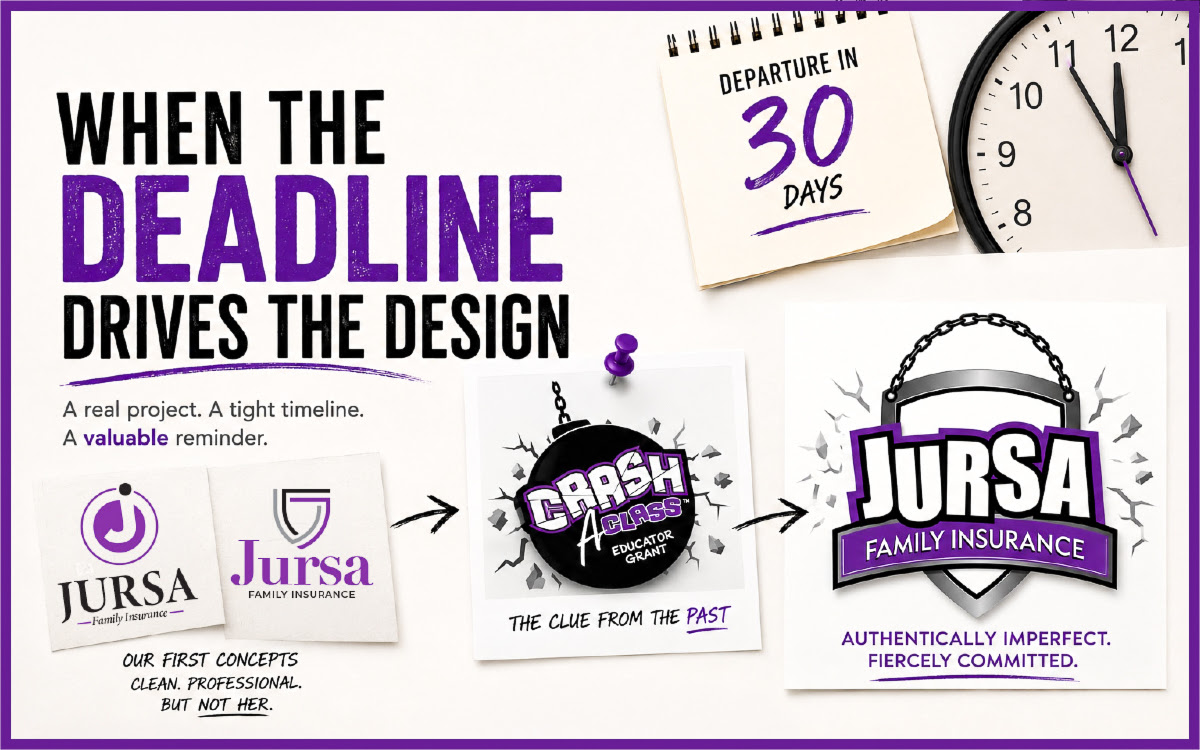
She was building a business while navigating a difficult professional transition, and she had a long-planned European trip coming up in 30 days.
She needed things in place before she left. There were real financial implications if they weren’t.
So, despite knowing how important discovery is to good branding, we compressed the process.
Our first concepts were polished. Professional. Thoughtful.
But they didn’t feel like Shannan.
What happened next reminded me that sometimes experience isn’t about getting everything right the first time. It’s about recognizing when something isn’t working, putting your ego aside, and listening differently.
Feedback Tips Creatives Love to Get:
1. Tell us what isn’t connecting.
Does it feel too formal? Too safe? Too long? Not quite like your brand? Is something important missing?
You don’t have to know how to fix it. Sharing what feels off gives your creative team a better starting point for the next round.
2. Share the destination — and let us help find the route.
Instead of rewriting the headline, tell your writer what you want the reader to understand or feel.
Instead of rearranging the design, tell your designer what you’d like to come through more clearly.
Knowing the goal gives creatives the freedom to explore the best way to get there.
3. Examples can say what words sometimes can’t.
“Make it pop.” “More elevated.” “Edgier.”
We’ve all used them — but those words can mean something different to everyone.
See something you love? Show us and tell us what you love about it. The colors? The energy? The simplicity? The personality?
That context can be incredibly helpful.
Great creative work is collaborative.
Shout-out to Erin Thomas
for the inspiration and advice!
When the Deadline Meets the Design Process
I’ll admit, I thought our history with Shannan gave us an advantage.
We weren’t meeting her for the first time. I knew her personally and professionally. MARQUEE had already successfully designed for her. Surely we could shave a little time off the normal branding discovery process and still get where we needed to go.
We couldn’t.
And that’s probably the first lesson I took from this project: knowing your client isn’t necessarily the same thing as knowing the brand they’re trying to become.
Shannan wasn’t simply choosing a new logo. She was trying to determine what a business bearing her family’s name should look and feel like, while simultaneously dealing with the circumstances that made creating it necessary.
We were asking her questions. She was answering them. But sometimes she knew what she didn’t want more clearly than she could explain what she did.
That’s hard for a designer.
Our first concepts were clean and professional. They checked a lot of the traditional boxes.
Shannan didn’t connect with them.
So we tried again.
We brought in another of MARQUEE’s senior designers, bringing a completely fresh creative perspective to the project. More concepts. More conversations. More exploration.
Still not quite Shannan.
At some point, you have to stop asking, Why doesn’t the client like what we’re showing her? and start asking a different question:
What are we not hearing?
The Answer Was Already There
That’s when we went back to Crash-A-Class.
MARQUEE had created the identity for Shannan’s teacher grant program in 2025, and she had always loved it.
Here’s where I’ll let you in on another behind-the-scenes truth: it wasn’t necessarily the logo our designers would have chosen as inspiration for an independent insurance agency.
But Shannan loved it.
More importantly, she identified with it.
That mattered more.
Once we stopped seeing the Crash-A-Class logo as just an old design and started asking why Shannan connected with it, things began to click.
It had personality. It wasn’t overly corporate. It was approachable. Confident. A little unexpected.
It felt like her.
And that gave our designers something Shannan had been struggling to put into words.
The new direction began taking shape from there. And eventually we got the response we’d been trying to get all along:
That’s me.
The Client Doesn't Have to Speak “Designer”
I think that’s one of the biggest lessons I’ll carry from this project.
Our clients hire us because we’re supposed to speak designer, marketer, writer, media buyer, event planner or strategist.
They don’t have to.
“I don’t like it” may really mean, “I don’t recognize myself in it.”
A client showing us something we wouldn’t necessarily choose may be giving us the most useful piece of creative direction we’ve received.
And a client who can’t articulate exactly what she wants isn’t necessarily failing at discovery. Maybe we haven’t asked the question in the way she needs to hear it yet.
There’s another lesson here that belongs to us.
When we tell a client, “Yes, we can meet that deadline,” that carries a responsibility.
Shannan’s deadline was legitimate. We wanted to help her meet it. But in trying to accommodate the circumstances, we underestimated what we were asking both Shannan and our creative team to accomplish in such a compressed period.
Meeting the client’s deadline was important. Protecting the process should have been important, too.
Sometimes the best thing we can tell a client isn’t simply, “Yes, we can do that.”
It may be: “Here’s what we can realistically accomplish by then. Here’s what we shouldn’t rush. And here’s why.”
We eventually got there with Jursa Family Insurance. The resulting identity is one Shannan is excited to put her name on, including a tagline that couldn’t be more appropriate:
Proudly Authentic. Fiercely Committed.
In retrospect, authentic was what we had been searching for the entire time.
We went through two of MARQUEE’s top designers. We explored directions that we thought worked better than Shannan did. We doubled back to something we’d created before. And ultimately, we arrived at a brand she can genuinely see herself in.
Would I have preferred a straighter path?
Absolutely.
But I wouldn’t change the lesson.
The best brand isn’t the one I love most. It isn’t the one our designer loves most. It’s the one that authentically represents the client and connects with the people they need to reach.
Thirty-plus years into this business, apparently I still need reminders every once in a while.
I’m good with that.
Because experience shouldn’t mean believing you always have the answer.
Sometimes it means knowing when to stop talking long enough to hear it.