
Your Name Is a Brand
Why Personal Branding Matters for Professionals
For decades, professionals built their reputations through credentials, referrals, relationships, and results. Those things still matter.
But today, long before a potential client schedules a consultation, makes a referral, or picks up the phone, there’s a good chance they’ve already looked you up online.
What they find – or don’t – shapes their perception of you. Forbes recently explored this in an article Why Personal Branding Matters More Than Ever Today, noting the risks of allowing others to define it for them.
That’s why lawyers, physicians, architects, consultants, authors and other professionals are recognizing that personal branding matters.
Youngstown Author and Historian Tom Welsh recently took a fresh look at this. He already had the credentials, published works, and decades of experience. What Tom didn’t have was a cohesive visual identity that connected his work as an author, historian, and biographical specialist to present him at a professional level.
For decades, professionals built their reputations through credentials, referrals, relationships, and results. Those things still matter. But today, long before a potential client schedules a consultation, makes a referral, or picks up the phone, there’s a good chance they’ve already looked you up online.
What they find—or don’t find—shapes their perception of you.
That’s why personal branding is no longer reserved for celebrities, influencers, or entrepreneurs. For lawyers, physicians, architects, consultants, authors, and other professionals, your name is a brand.
And personal branding isn’t about creating a persona or turning yourself into a product. It’s about intentionally presenting the experience, expertise, and reputation you’ve already built.
In fact, Harvard Business School Online describes personal branding as the intentional and strategic process of defining and expressing your value. The goal is to make the narrative surrounding you accurate, coherent, compelling, and differentiated.
That distinction matters.
Think about a respected attorney whose business card hasn’t changed in 15 years. A physician using an outdated headshot. An architect whose impressive body of work is scattered across different websites and social platforms. Or an accomplished professional whose email address and LinkedIn profile don’t reflect the caliber of their work.
None of those things diminish their expertise. But they can diminish the perception of that expertise.
And in a crowded marketplace, perception matters. As Forbes recently explored in Why Personal Branding Matters More Than Ever Today, professionals who don’t intentionally communicate their own story risk allowing others—or their absence from the conversation—to define it for them.
From Accomplished Author to Recognizable Brand
MARQUEE recently worked with Youngstown author, historian, and biographical specialist Thomas G. Welsh on exactly this challenge.
Tom already had the credentials. His published work includes books exploring Youngstown’s religious, cultural, and commercial history, and his professional services extend beyond traditional authorship into personal and family history storytelling.
What he didn’t have was a cohesive visual identity connecting those pieces.
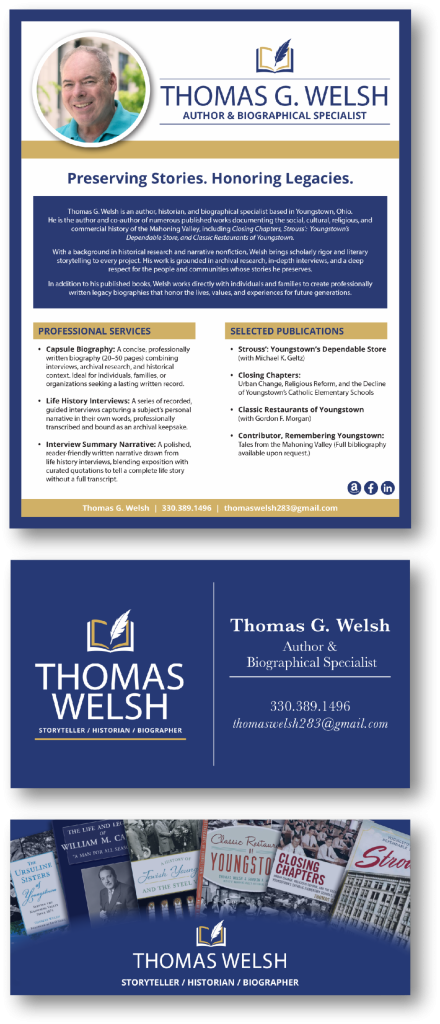
The branding process began by defining how Tom wanted to be positioned and what audiences should understand about his work. From there, MARQUEE developed a visual identity and logo, color and typography recommendations, tagline and messaging direction, and then translated that identity into practical tools he could actually use.
The resulting package included business card design, a professional media sheet, branded digital elements, social media graphics, and coordination of updated professional photography.
The result isn’t a different Thomas Welsh.
It’s a clearer presentation of the Thomas Welsh who was already there.
What Does Your Brand Say About You?
A strong personal brand creates consistency. Your business card should feel like your LinkedIn presence. Your professional photograph should support the same impression as your biography. Your website, presentation materials, and media appearances should reinforce the same story.
And that consistency builds recognition and credibility.
For established professionals, this can be particularly important when pursuing opportunities beyond the networks where they are already known. Locally, your reputation may precede you. Nationally—or even with someone across town who hasn’t met you yet—your brand often has to introduce you first.
Personal branding doesn’t necessarily require starting with a massive website or marketing campaign. Start with the essentials: How are you positioned? What do you want to be known for? Does your visual identity reflect the level at which you work? And when someone searches your name, does what they find reinforce that story?
Tom’s branding project demonstrates what can happen when those pieces begin working together.
Because you’ve already spent years building your professional reputation.